
An Archive Most Fell
In which the company encounters the strange denizens of Hell's library...and we discuss combat mechanics...

Bright Crescent Company is my up-coming solo TTRPG where you take on the role of a Commander leading their Company into the Burning Lands. While only the Commander has stats, each company member provides various benefits: advantage against certain types of enemies, healing, protection from damage, or easier navigation.
This will be a hybrid mechanics discussion and playthrough, where the bulk of the fiction will come from excerpts from the Company’s campaign log. I won’t display all the rolls, but I will discuss those that introduce new mechanics or otherwise result in interesting (or deadly) events.
NOTE: there will be mechanic changes exhibited in these posts as issues arise and require fixing.
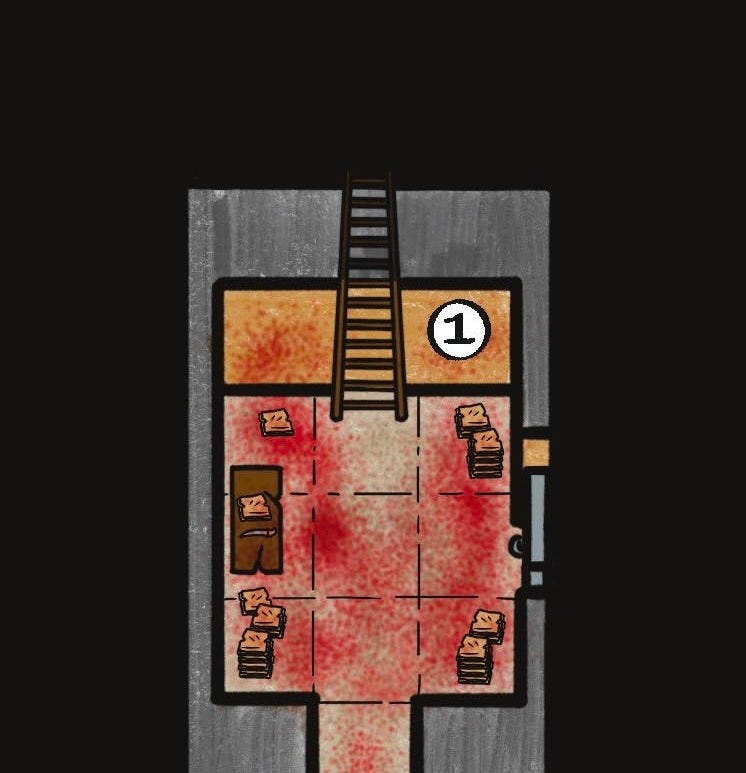
“The archives smelled of sulfur mixed with blood, and it didn’t take us long to determine the source. A creature with far too many eyes and four arms sheared the skin off of its victims with a practiced ease even the most skilled field dresser could never have accomplished. Griff tried to lead us around the creature, who was intent on its work, but the Commander’s heavy armor betrayed us and we were forced to fight.”
— Excerpt from Morfel the Hammer’s campaign log
I decided to fast track the play through, in hopes that I could get through a bulk of the game quickly and get the final edits completed and the game released. This segment of the play test took me through four levels of the Burning Lands, beginning in the Infernal Archives (Level 3) and ending in the Glooming Wastes (Level 6). Or at least, that was the plan…as you’ll see, it didn’t exactly work out that way.
There were a lot of combat encounters here, with one taking ten turns. I found myself on the brink of death a couple times, and made use of the Break mechanic to restore health at least three times. Fortunately I never had an interruption, so my hit protection was back to full before engaging a new foe.
Breaks are short periods of time where the Company halts and rests. The Commander restores their Hit Protection to maximum and unit advantages reset. The danger lies in the potential of an interrupted Break. Every time you take a Break, roll a d6. On a 1, your break is interrupted. It might be a roving demon, or some unforeseen environmental hazard. It prevents the Commander from fully recuperating (restore half, or 8 HP, instead), but does rest unit advantages.
I think the more I work on this dungeon crawler the more I find myself unsatisfied with the standard combat loop. That’s not a shot at BCC, it’s not doing anything new, but a reflection of TTRPG combat in general. Aside from narrative heavy games like Ironsworn, most TTRPG combat revolves around a “to-hit” roll against a target number—whether that’s the enemy’s level, Armor Class, or something else—followed by a damage roll if the “to-hit” was successful. Unlike in turn-based RPG video games where there’s dynamic visuals and audio, this kind of combat in TTRPGs often feels like an exercise in insanity (as in, doing something over and over again expecting a different result).
Even in group games, it’s not uncommon for the group to spend an entire three or four hour session (sometimes more than one!) fighting a single group of enemies. BCC isn’t quite that extreme, but if I’m bored by round 6 of combat where I’ve only hit the enemy for 2-3 points of damage and, on the flip side, have only taken a point or two myself, I can’t imagine others would enjoy it. Something needs to change.
I recognize that this rant may be indicative that my taste is beginning to turn. I’ve played a fair few of these Dark Fort-like dungeon crawler games, from popular ones like Dark Fort itself and Four Against Darkness to indie titles such as Aaron Best’s Pulp Dreadful. There’s a deadly simplicity in the combat mechanics of Dark Fort and 4AD. Even Pulp Dreadful, with its d20 roll under resolution, is simple and deadly—though not always quick.


Both Dark Fort and 4AD make use of a single d6 against a target number. Four Against Darkness allows characters to add various modifiers to their attack roll which raises the chance of a hit, but doesn’t roll damage at all. Instead, the result of a successful d6 roll kills one or more of the enemies. After all PCs have attacked, they defend against the enemies’ attacks by rolling that same d6 and looking for a result higher than the enemy level. It’s clean and efficient, deadly and relatively quick.
I considered dropping the 2d6 + mod Attack/Defend mechanic for a single d6 roll against a target number ranging from 3 to 6 (akin to Dark Fort). Basic enemies would have a target of 3 or 4, challenging enemies would need a 4 or 5 to hit, and boss enemies requiring a 6. But, in experimenting with this I found that basic and some challenging enemies were dead in a couple rounds with very little risk, while a boss fight could run ten or more turns. Too much swinginess in combat isn’t ideal (or fun, in my opinion).
In Oathbound: Trials of Caernlun, the game that this one is dependent upon, the knight added their Valor (roughly equivalent to Strength) to both Attack/Defend rolls as well as to damage rolls. Adding this to Bright Crescent Company gets rid of one of the biggest hurdles to the game’s combat, namely hitting and doing no damage (which adds bloat). The experiment example below is indicative of the multiple combat scenarios I’ve run between Trials and BCC. It’s taken far too long to figure out the problem and the solution has been staring me in the face.
Mechanic Experiment: Reduced DR + Stat Added to Damage (Challenging)
Fellhand Champion (Humanoid) DR10, HP18, AR2, d6/a hammer
Round 1:
Attack: 2d6 + 2 STR vs DR10 = 10 → d6 + 2 = 7 - AR2 = 5 damage (13/18)
Defend: 2d6 + 2 STR vs DR10 = 10, success
Round 2
Attack: 2d6 + 2 vs 10 = 10 → d6 + 2 = 3 - AR2 = 1 damage (12/18)
Defend: 2d6 + 2 vs 10 = 7, fail → d6/a = 6, 4 → 6 damage (PC 10/16)
Round 3
Attack: 2d6 + 2 vs 10 = 12 → d6 + 2 = 6 - AR2 = 4 damage (8/12)
Defend: 2d6 + 2 vs 10 = 11, success
Round 4
Attack: 2d6 + 2 vs 10 = 10 → d6 + 2 = 6 + 3 + 2 - AR2 = 9 damage → defeated
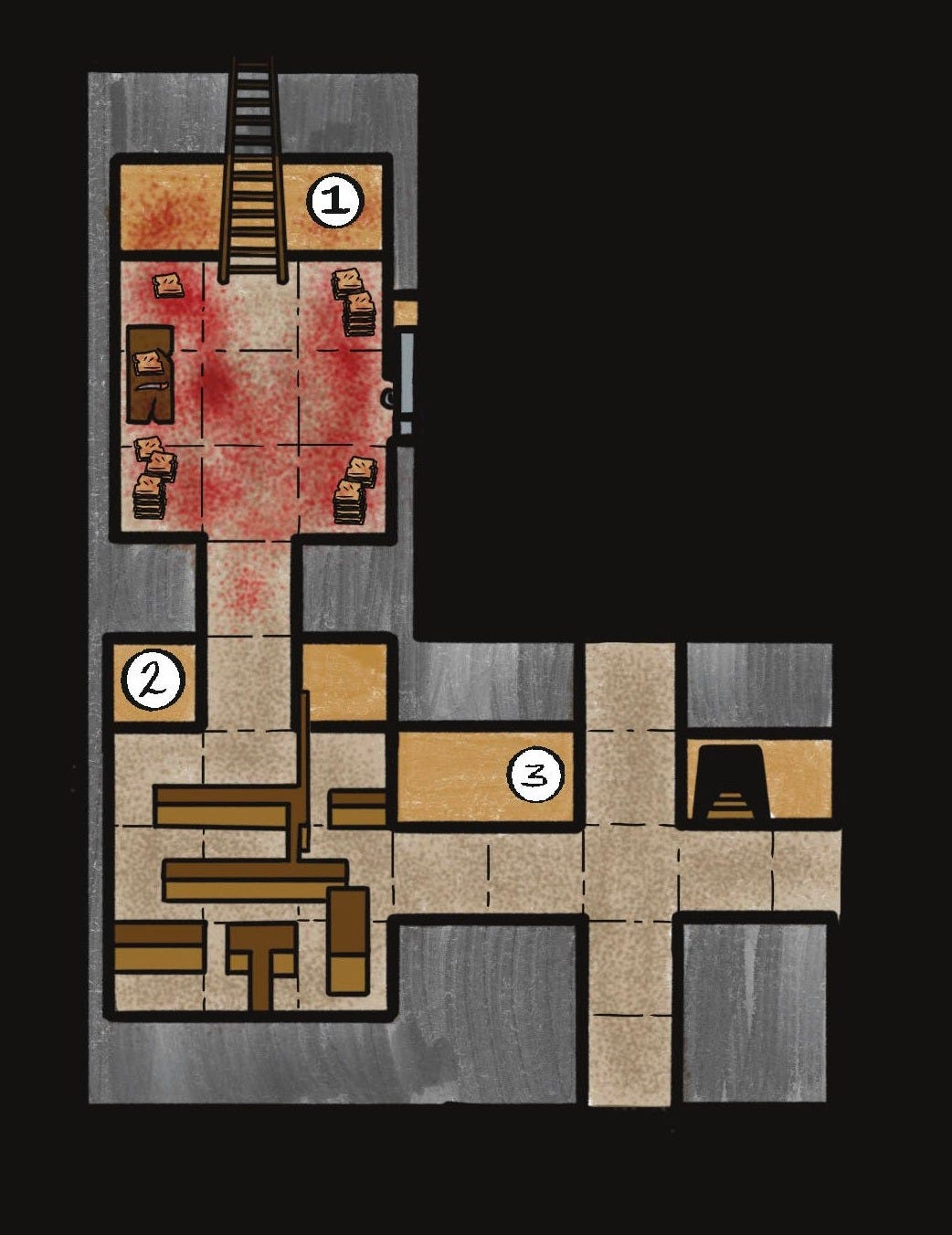
“As if that many-eyed creature wasn’t weird enough, there was an actual labyrinth in one of the chambers. The walls rose from floor to ceiling, cut bricks of a dusky red, and cut back and forth on each other in such a way that I quickly became disoriented. In an exceptional display of mental acuity, Griff led us confidently through each new twist and turn until we reached an exit that, if I’m honest, I wasn’t sure would lead us forward. The Commander had no such uncertainty. Not only did he find the door forward, he found another crudely carved runestone, this one, according to Afdan, was designed to cure poison.”
— Excerpt from Morfel the Hammer’s campaign log
The Infernal Archive was another level that I enjoyed creating. It’s meant to be the repository for all of the demon’s history, lore, magic, and science. The many-eyed creature—a Watcher Fellmonger—the company met in the previous campaign log entry serves the demonic scholars by making new parchments…out of the skin of the demon horde’s victims and dead demons alike. In this new chamber, the Company stumbled into a test of mental agility and memory—traits the demon scholars hold in highest regard.
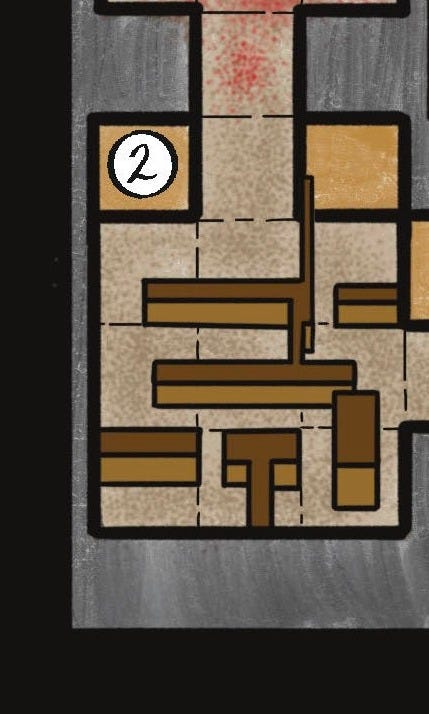
This skill check resulted in the rare critical success (two sixes on the dice). Griff handily navigated the labyrinth and led the Company out the other side. I found I was dissatisfied that such a scarce result would go unrewarded. So, I decided that critical hits on skill checks should provide a bonus, even when a reward for success isn’t specified in the table entry. In this case, I opted to roll once on the Treasure table and came up with a Rune of Antitoxin, which can be used, as the name suggests, to automatically purge the Commander of the poisoned condition. I’ll be adding some suggestions for rewarding critical success on a skill check in the final version of the game.

The next chamber saw Griff and Company discovering the stairs down to the next level, the Glooming Wastes! We’ll pick up with the adventure and development discussion in the next one.
Change Log:
Further altered combat to include adding the STR modifier to damage
Added suggestions for rewarding critical successes on Skill Checks
An Archive most fell and full of fallen, not a pleaaent place, for this is hell.
Combat is so hard for pen and paper game. When I played Mork Borg solo, I felt like some combats were scary, some were fun and visceral, but many went on far too long. I think the more I swim in the fiction of the combat, the more fun it is as opportunities for non standard moves pop up (like pushing someone over, getting the high ground, hiding and ambushing ect) But some systems lend itself to it much more than others