
Commander & Company
Creating a Character in Bright Crescent Company

Bright Crescent Company is my up-coming solo TTRPG where you take on the role of a Commander leading their Company into the Burning Lands. While only the Commander has stats, each company member provides various benefits: advantage against certain types of enemies, healing, protection from damage, or easier navigation.
This will be a hybrid mechanics discussion and playthrough, where the bulk of the fiction will come from excerpts from the Company’s campaign log. I won’t display all the rolls, but I will discuss those that introduce new mechanics or otherwise result in interesting (or deadly) events.
NOTE: there will be mechanic changes exhibited in these posts issues arise and require fixing.
In Bright Crescent Company, character creation occurs in two parts. First, you create your Commander. The Commander is the player character, whose Skills are used to make attacks and skill checks throughout the game. The second component is the Company. There is a list of eleven different units and you choose four of them. Each Company unit provides the Commander a bonus, usually to attack rolls against specific demon types.
Before I wrote the prologue, I sat down with the play test version of the game and got to rolling. Bright Crescent Company presents two 2d6 name tables to roll on. All of the names were adapted from The Old North’s “Brythonic Personal Names” list to keep that post-Roman Britain feel that pervades both Bright Crescent Company and Oathbound. I rolled a 7, giving me Griffid.
Note: A while back I did some genealogical research into my paternal lineage. My great-grandmother’s paternal line—Griffin— goes all the way back to Gruffudd ap Llywelyn, the only Welsh king to unite all of Wales (ca. 1055-1063 CE).
Commanders begin their mission with 16 Hit Protection. There’s no rolling for HP here. Sixteen HP provides a decent buffer between survival and death for a single character in a very dangerous environment. I want the game to be a challenge, but I don’t want it to end in three rooms because of terrible rolls.
Next up, we determine our Skills. There are only three in Bright Crescent Company, and instead of going with the more knightly oriented skills in Oathbound, I opted to use the familiar Strength, Dexterity, and Willpower. The game presents three stat arrays, keyed to present some level of difficulty selection. I opted for the default stat array (“Warrior” difficulty), and assigned the 3 to Strength, the 2 to Willpower, and the 1 to Dexterity.
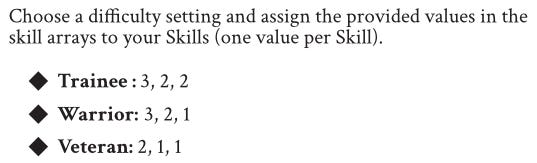
While DEX is an important skill, especially in the many skill checks (both to avoid a hazard/special attack, and to sneak), I knew that I wanted Griffid to be a heavily armored Commander, which would make him struggle with DEX checks anyway. To that end, we can discuss the next stage of character creation: Equipment.
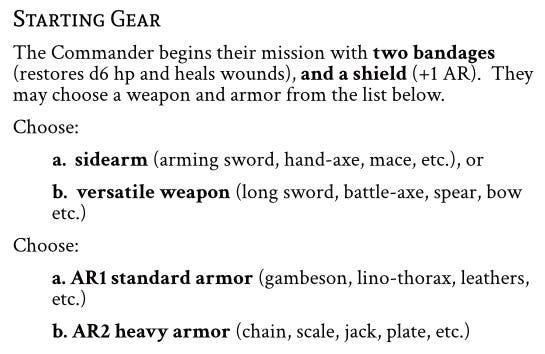
I chose to take a versatile weapon (a longsword). Versatile weapons can be used with either one hand or two. Using it one-handed gives it a d6 damage dice, while using it with two hands allows you to roll two d6s and take the highest (d6/a). The downside to the higher potential damage is that you can’t carry a shield and use the two-handed attack.
I also opted to give Griffud “heavy” armor. Like weapons, the kind of armor you wear in Bright Crescent Company is mostly about the fiction, or your mental image of your Commander. The type of armor (i.e. leathers, chain mail, scale mail, etc.) doesn’t really matter. What does matter, mechanically, is whether it’s “standard” or “heavy.” Standard Armor gives 1 Armor Rating, allowing you to negate 1 point of damage from most sources. Heavy Armor gives an Armor Rating of 2, but also a -2 penalty to DEX checks (as it’s cumbersome and loud).
You always start out with a Shield, which provides another 1 Armor Rating, assuming you have it “equipped.” For the beginning of Griffud’s descent into the Burning Lands, he carries his shield and uses his weapon one-handed, giving him a total Armor Rating (or AR) of 3. This, I hope, will increase his survivability.
That’s it for Commander creation. It’s a quick process that requires only one roll (for the name), and a few choices. Next up, we get to choose our four Company units. These units do not have stats, HP, or inventories. They are, for all intents and purposes, character modifiers. If you choose to play the game with a more narrative focus, they also serve as someone for the Commander to communicate with and can add dramatic flair.
Each of the eleven Company unit options provide some kind of bonus, whether through advantage against certain demon types, or spells for healing, providing light, or curing conditions. These units are presented on a 2d6 table, so you can randomize it if you want. For this play test, I did a mix of rolling and choosing. My first playtest, which used a completely different dungeon content table (that didn’t work well), I used the Ranger, Cartographer, Shield Warden, and Archer. In this play test, as you might have noted in the prologue, I am using the Champion, Chirugeon, Hydromancer, and Pikeman.

And that’s it! Getting started takes all of five minutes. There’s no inventory management, no torches to track, no rations. Next time, our brave Company will descend into the Burning Lands’ first level—The Darkstone Tunnels. This won’t be a traditional actual play. Instead, I’ll be mixing some bits of fiction with mechanical discussion, showing how the game is played.
I'm getting excited about this one. There's a sweet spot between adventuring and wargaming that I think this type of game might fit nicely.
Hey Eric. I would say go for it. Lots of words there...would I play this? Maybe.